
How to Start a Land Clearing Business in 2026: A Complete Startup and Growth Guide
Launching a land clearing business in 2026 means blending hands-on contracting know‑how with smart equipment planning, permit navigation, and modern lead-generation. This guide walks you step-by-step through planning, choosing the right machines, securing permits and insurance, marketing to generate steady land clearing leads, and practical scaling strategies to grow revenue and operations. Many new owners underbudget startup costs, underestimate the range of service lines like forestry mulching and stump grinding, and overlook the marketing effort needed to keep crews busy. This playbook fixes those gaps with actionable checklists, financing comparisons, and operational templates. You’ll learn how to pick a legal structure, finance and maintain core machines, get required permits, launch immediate marketing that produces leads, and build a growth roadmap for expanding into complementary services. Each major section includes short lists, EAV-style comparisons, and 30/60/90-day implementation steps so you can turn leads into profitable jobs quickly. By the end you’ll have a practical startup blueprint and optional resources — including downloadable templates — to accelerate growth.
What Are the Essential Steps to Develop a Land Clearing Business Plan?
A solid business plan makes your services, pricing, and market positioning clear — and gives you a roadmap to profitability. For a land clearing business this means mapping demand drivers (construction site prep, wildfire mitigation, solar clearing) and matching service lines like forestry mulching, brush clearing, and stump grinding to those opportunities. The result: a focused operations and revenue forecast that guides equipment buys and sales activity. Start with an executive summary that states your service mix and service area, then follow with market analysis showing demand sources and gaps in the competition. Operations should spell out staffing, equipment rotation, transport logistics, and a maintenance schedule to protect margins in year one and two. Financials need a startup-cost breakdown, conservative revenue scenarios, and a cash‑flow plan that shows when key investments return value.
A short action checklist moves planning into execution:
- Define service offerings and target clients with projected pricing.
- Build a 12‑month revenue and expense forecast with breakeven analysis.
- Document operational plans: equipment logistics, staffing, and safety protocols.
- Outline sales and marketing activities for lead generation and conversion.
Use this checklist to turn strategy into tasks you can present to lenders, partners, or team members.
How to Choose the Right Legal Structure for Your Land Clearing Business

Your legal structure affects liability, taxes, and capital options — so pick based on risk tolerance and growth plans. Common choices are sole proprietorships, LLCs, and corporations. An LLC usually offers a practical balance of liability protection and pass‑through taxation for small operator-owners, while a corporation can make sense if you expect outside investors. Consider how each structure handles workers’ comp, equipment liens, and contract obligations; liability protection is critical when heavy machinery and hazardous sites are part of daily work. Typical formation steps include choosing a business name, filing with the state, and getting an EIN for payroll and taxes.
Compare these factors to decide what fits your goals:
- Level of liability protection
- Tax treatment and ongoing administrative requirements
- Ease of bringing on partners or investors
- Upfront and recurring costs for formation and compliance
Picking the right structure reduces personal exposure and lines up with your growth and financing strategy.
What Financing Options Are Available for Land Clearing Startups?

Financing equipment and working capital is often the first big decision: heavy machines carry high price tags, but the right financing preserves cash flow. Common sources include bank equipment loans, dealer financing, equipment leases, SBA loans, lines of credit, and private investors. Each option trades off down payment, interest rate, term length, and flexibility. For example, a $150,000 equipment purchase might need 10–20% down with a 3–7 year bank amortization, while dealer financing can offer promotional terms or staged upgrades. Leasing lowers upfront cost but may be pricier over time; SBA loans offer competitive rates but take longer to close.
Use the table below to match financing to your cash-flow needs.
| Financing Type | Typical Terms | Best For |
|---|---|---|
| Bank Equipment Loan | 3–7 year amortization, 10–20% down | Owners with strong credit who want ownership |
| Dealer Financing | Flexible down, promotional rates | Quick purchases and trade‑in options |
| Equipment Lease | Lower upfront, monthly payments | Conserving cash or rotating fleet frequently |
| SBA Loan | Lower rates, longer terms, more paperwork | Larger purchases with a long-term plan |
| Line of Credit | Revolving access to working capital | Short-term cash needs and deposits |
Choose based on credit profile, urgency, and whether owning equipment or keeping flexibility matters more; align terms with your 12–24 month growth plan to avoid cash squeezes.
Which Equipment Is Necessary for a Successful Land Clearing Business in 2026?
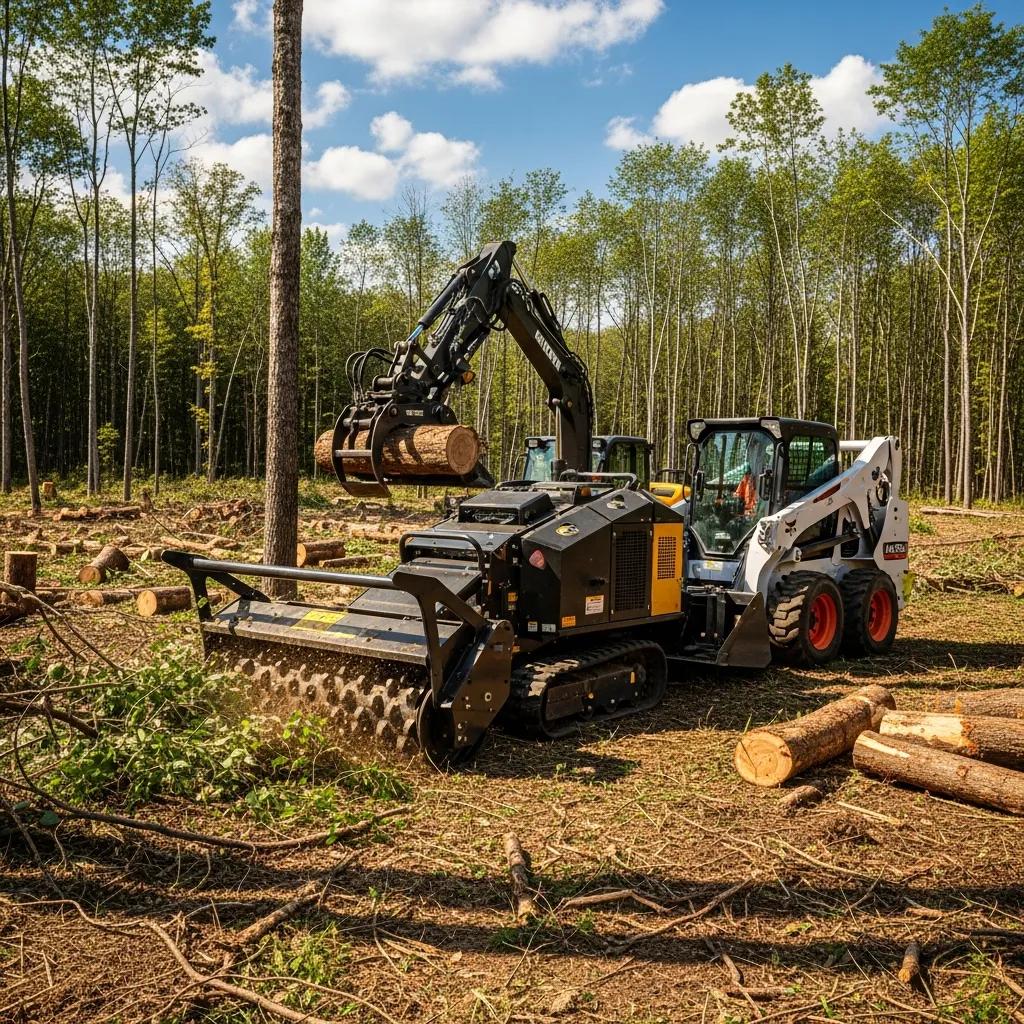
Your fleet determines what jobs you can take and the margins you’ll earn. The right mix balances power, transportability, and ease of maintenance. Core machines include forestry mulchers and mulching-head attachments, skid steer loaders (wheeled or tracked), mid-size excavators, dozers for grading, stump grinders, and reliable trucks and trailers. Don’t forget PPE and safety gear — they reduce downtime and insurance hassle. Choosing between a dedicated forestry mulcher and a mulching-head on a carrier depends on job density, budget, and attachment compatibility. A thoughtful fleet plan boosts utilization and lets you bid projects from small residential lots to large commercial parcels. Preventive maintenance and telematics extend uptime, while transport planning — trailer size and oversized load permits — affects scheduling and cost.
The equipment list below maps common clearing tasks to buy/lease decisions and cost expectations:
- Forestry mulcher: handles dense brush and timber; higher upfront cost.
- Skid steer (with mulching head): flexible, easy to trailer between jobs.
- Excavator: root and stump removal, grading and site prep.
- Stump grinder: efficient stump removal and cleaner finish work.
- Haul truck + trailer: moves machines and debris — essential for remote sites.
This mix lets you offer a range of land management services and price competitively while protecting margins.
What Are the Essential Land Clearing Machines and Tools?
Knowing each machine’s role and typical cost helps prioritize purchases or leases based on your early sales forecast and target projects. A forestry mulcher drives revenue on large-acreage jobs, while a skid steer with a mulching head is cost-effective for tight residential access and general versatility. Excavators and dozers handle heavier earthwork and construction site prep, and stump grinders are essential for post‑clearing cleanup. Support gear — trailers, chainsaws, chippers, and PPE — keeps turnaround times low and jobs profitable.
| Machine | Typical Use | Approx. Cost Range |
|---|---|---|
| Forestry Mulcher | Dense brush and timber mulching | $80,000–$250,000 |
| Skid Steer + Attachments | Versatile clearing & material handling | $30,000–$90,000 |
| Excavator | Root removal, grading, heavy digging | $70,000–$200,000 |
| Stump Grinder | Efficient stump removal | $8,000–$40,000 |
| Trailer & Truck | Transport machinery and debris | $20,000–$120,000 |
How to Maintain Equipment and Ensure Operational Safety?
Preventive maintenance and good operator training cut breakdowns and keep insurance costs in check. Put daily operator checks, regular fluid and filter changes, undercarriage inspections, and a written maintenance log into practice; telematics will automate service alerts. Safety protocols should cover PPE standards, lockout/tagout procedures, traffic control for roadside work, and a site hazard assessment before any job starts. Investing in operator certifications raises productivity and lowers accident risk, and clean post-job cleanup practices improve client satisfaction and referrals.
A short maintenance and safety checklist to follow daily and weekly:
- Daily pre-start inspection and site hazard assessment.
- Weekly lubrication and safety-system checks.
- Monthly service items and telematics review.
- Ongoing operator training and incident debriefs.
These routines preserve asset value, keep crews productive, and reduce unplanned downtime.
What Legal Permits, Licenses, and Insurance Are Required for Land Clearing Businesses?
Land clearing touches environmental rules, local land-disturbance permits, and municipal codes — so knowing the right permits and insurance keeps projects moving. Common permit types include land disturbance/erosion control, wetlands or habitat permits, and local site-development approvals; some jobs require stormwater and erosion-control plans. Insurance is equally important — general liability, workers’ compensation, commercial auto, and equipment coverage guard against injury, property damage, and equipment loss. Research state and local rules early to avoid delays or stop-work orders; for complex projects, consult an attorney or environmental specialist.
Use the compact insurance comparison below when planning coverage.
| Insurance Type | Coverage Focus | Typical Cost Drivers |
|---|---|---|
| General Liability | Third-party bodily injury and property damage | Revenue, claims history, operations type |
| Workers’ Compensation | Employee injury and medical benefits | Payroll levels, state rates, safety record |
| Commercial Auto | Vehicle accidents and cargo liability | Fleet size, driving records |
| Equipment Insurance | Physical damage/theft of machinery | Replacement value, storage, usage |
How to Navigate Land Clearing Permits and Licenses by State?
Build a repeatable research process for state and local permits to save time and avoid compliance problems across service areas. Start by confirming project jurisdiction — city, county, and state — then check permitting authorities for land disturbance and environmental rules (state environmental agencies and local planning departments are typical sources). Create a checklist for each jurisdiction that records required documents, review timelines, and inspection triggers, and keep a permit folder for each project. For work near wetlands or protected habitat, bring in an environmental consultant early to identify mitigation needs and prevent costly redesigns.
A practical permit-finding workflow:
- Confirm project jurisdiction and relevant agencies.
- Identify permit types: land disturbance, erosion, and wetland permits.
- Compile application requirements and typical review times.
- Engage consultants for projects with complex environmental concerns.
This process reduces surprises and helps you present bids that are dependable and compliant.
What Insurance Types Protect Your Land Clearing Business?
Balancing insurance cost with coverage is about managing risk and meeting client contract requirements. Essential policies form a baseline for most clearing contractors: general liability for third‑party injury or property damage, workers’ compensation for employee injuries, commercial auto for vehicles and trailers, and equipment insurance to cover damage or theft. Premiums are driven by payroll size, claims history, driver records, and equipment value; improving safety practices and documenting maintenance can lower rates over time.
| Coverage | Why It Matters | Cost Considerations |
|---|---|---|
| General Liability | Protects against client property damage and injuries | Limits and deductible choices |
| Workers’ Compensation | Required in most states for employee coverage | Payroll and industry classification |
| Commercial Auto | Covers transport and on-road incidents | Fleet composition and driving records |
| Equipment Insurance | Replaces or repairs heavy machinery | Age, value, storage, usage patterns |
Match policies to your operation’s scale and risk profile to minimize exposure while keeping bids competitive.
How Can New Land Clearing Businesses Effectively Market and Generate Leads?
Generating land clearing leads in 2026 means combining local visibility, targeted advertising, proof-of-work content, and field partnerships. The idea is to be where decision-makers search: optimize your Google Business Profile (GBP), build location pages, and collect reviews — then layer geo-targeted paid search and social campaigns to capture active demand. Offline, network with builders, landscapers, and developers and offer referral incentives. A defined sales process with site‑visit qualification, transparent quotes, deposits, and clear contracts boosts close rates and protects margins. When you stack digital and field tactics, you smooth out seasonality and build a consistent pipeline.
Top channels and quick-start actions:
- Local SEO: optimize GBP and business citations; gather client reviews.
- Google Ads: run geo-targeted search campaigns for service queries.
- Social Ads: use Facebook and TikTok to show short before/after project videos.
- Partnerships: set referral agreements with contractors and developers.
- Content & Video: publish case studies and safety-first content to build trust.
These channels complement each other — SEO captures organic demand, paid ads scale reach, and partnerships provide high‑conversion referrals — creating a diversified acquisition strategy.
Rise Online Advertising’s Land Clearing Growth System is an option for teams that want agency-led acceleration after they’ve set up operations. The system focuses on land clearing and forestry mulching companies with tailored SEO, website builds, and paid media to scale lead generation. Rise also provides free training videos, resources, and a free book on scaling land clearing businesses for owners who prefer structured guidance. Use these services to supplement your DIY marketing and accelerate growth.
What Marketing Strategies Drive Land Clearing Business Growth?
A focused 30/60/90 plan delivers immediate leads while building long-term visibility and social proof. Start with GBP and local citations to capture nearby searches, then run a small Google Ads test for keywords like “land clearing near me” and target the right zip codes. Produce short project videos showing mulching and cleanup for social feeds and retarget site visitors. Collect reviews and create a before/after gallery to include in proposals — these assets cut buyer hesitation and increase close rates. Over 60–90 days, scale paid campaigns, improve landing pages for conversions, and invest in SEO content that targets project-specific queries.
Practical 30/60/90 checklist:
- 0–30 days: GBP optimization, three local citations, one Google Ads test campaign.
- 30–60 days: Produce two project videos, start social retargeting, gather client reviews.
- 60–90 days: Expand SEO content, refine ad geo-targeting, implement conversion tracking.
How to Acquire and Convert Land Clearing Jobs Successfully?
Turning leads into profitable jobs relies on a tight sales process, solid qualification, and contracts that control scope. Start with a discovery call to confirm project type, access, and environmental limits, then book a site visit using a standard inspection checklist (access routes, utilities, nearby wetlands). Price by hour, per acre, or per project, and include machine hours, transport, disposal, and contingency buffers. Require deposits for larger jobs and use clear scope‑of‑work contracts with start/end dates, payment terms, and change‑order procedures to avoid disputes and scope creep.
Key sales templates and steps:
- Lead qualification questions and discovery call script.
- Site‑visit checklist covering access, hazards, and client expectations.
- Sample contract clauses for deposits, change orders, and insurance requirements.
Standardizing the sale-to-delivery workflow cuts negotiation time and increases the chance of on-time payment.
What Strategies Help Scale and Diversify a Land Clearing Business in 2026?
Scaling depends on operational systems, selective service expansion, and disciplined capital allocation so you add capacity without shrinking margins. High-return diversification options include demolition, grading, erosion control, or wildfire mitigation services — these add value per job and create cross-sell opportunities. Operational scale uses equipment rotation, a hire-or-subcontract model for overflow, and repeatable regional playbooks to open new territories with predictable margins. Invest in hiring and training systems, telematics for utilization tracking, and simple KPI dashboards to monitor margins as you add crews and machines.
A strategic scaling checklist:
- Pilot one complementary service with dedicated pricing and cost tracking.
- Implement equipment rotation and preventive maintenance schedules.
- Build a subcontractor network for peak demand and specialty tasks.
- Create a hiring and training pipeline tied to utilization triggers.
How to Expand Services and Increase Revenue Streams?
Test new services on a small scale to limit capital risk while proving demand and profitability. Offer high‑margin add-ons like erosion-control mats, silt-fence installation, or post-clearing grading as optional line items to raise average ticket size. Cross-sell to construction and landscaping clients by bundling clearing with site prep. Price new services using direct labor and equipment hours plus a markup that preserves contribution margin; track pilot jobs and adjust pricing after three to five projects.
Pilot and pricing steps:
- Identify a complementary service and create a one‑page offer.
- Run three pilot jobs with tracked costs and customer feedback.
- Refine pricing based on actual hours and equipment utilization.
- Roll out successful pilots with a targeted marketing push to current clients.
What Are Best Practices for Hiring and Training Skilled Staff?
Hiring and keeping skilled heavy-equipment operators requires clear job specs, structured onboarding, and training focused on safety and productivity. Recruit through trade schools, local listings, and industry referrals, and use a standard job description that lists certifications, machine experience, and safety expectations. Onboarding should include site safety orientation, machine-specific checklists, and mentorship with an experienced operator for the first 30 days. Retention incentives — performance bonuses, predictable schedules, and paid training — boost loyalty and lower turnover costs.
Key hiring and training components:
- Clear job descriptions and targeted recruiting channels.
- Structured onboarding with safety and machine training modules.
- Ongoing skills assessments and performance incentives.
- Documented SOPs and a mentorship program.
Operational consistency depends on skilled crews; investing in training protects margins and client satisfaction.
For teams that want a faster path to steady leads and scaling support, Rise Online Advertising LLC offers a Land Clearing Growth System tailored to land clearing and forestry mulching companies. The system combines specialized SEO, website builds, and targeted paid media (Google Ads, Facebook Ads, TikTok Ads) with tactical training resources. Rise also provides free videos, resources, and a free book for owners who want structured, agency-led acceleration. Consider these options once your operational foundation is in place to speed growth.
This operational guidance ties strategic growth to practical hiring and marketing choices — owners who combine disciplined operations with focused lead generation are best positioned to scale profitably.
Frequently Asked Questions
What are the key challenges when starting a land clearing business?
Key challenges include high startup costs, navigating permitting and environmental rules, and securing the right equipment. Many new owners underestimate machinery and permit costs, and building a reliable client pipeline takes consistent marketing. You’ll also need to manage logistics, safety, and local market competition. Address these issues early to build a durable business.
How can I effectively manage cash flow in my land clearing business?
Good cash‑flow management starts with a detailed budget that tracks fixed and variable costs — maintenance, labor, fuel, and insurance. Require deposits for larger projects, use clear invoicing terms, and consider accounting software for real‑time tracking. A line of credit can smooth timing gaps; review financials regularly to spot trends and adjust pricing or expenses.
What safety measures should be implemented in a land clearing operation?
Safety is non‑negotiable. Implement a formal safety program with regular equipment and emergency training, enforce PPE (helmets, gloves, eye protection), and run daily site inspections. Have clear hazard‑reporting procedures and regular drills. Consistent safety practices protect people, reduce insurance costs, and improve client confidence.
How can I build a strong client base for my land clearing business?
Combine online visibility and local networking. Optimize your Google Business Profile, get listed in local directories, and show before/after project photos on social channels. Attend local trade events to meet contractors and developers, and offer referral incentives to partners and past clients. Demonstrated work and positive reviews drive trust and repeat business.
What are the benefits of diversifying services in a land clearing business?
Diversifying adds revenue and reduces seasonality. Offer services like grading, erosion control, or demolition to increase average job value and cross‑sell to existing clients. Diversification broadens your market and helps stabilize income when one service slows.
How do I stay compliant with environmental regulations in land clearing?
Research local, state, and federal rules that apply to land disturbance. Secure required permits, follow erosion-control and habitat-protection guidelines, and document compliance. For complex sites, consult environmental experts or legal counsel. Good compliance avoids fines and delays and strengthens your reputation.
What role does technology play in modern land clearing operations?
Technology improves efficiency and safety. Telematics helps track equipment hours and maintenance, drones speed site assessments and mapping, and project-management and invoicing software streamlines operations. Adopting these tools reduces downtime and positions your company as a professional, modern contractor.
Conclusion
Starting a land clearing business in 2026 can be profitable with the right planning, equipment choices, and marketing. Understand the essential steps, legal and insurance needs, and operational best practices to build a solid foundation. Use the checklists and templates in this guide, and tap additional resources if you want agency support or faster lead growth. Take the next step today and turn your experience into a scalable, profitable business.