
Best Land Clearing Companies in America: How Top Contractors Achieve Success and Who They Work With
The best land clearing companies in America combine safety, efficiency, and measurable growth strategies to win high-value contracts and sustain repeat business. This article explains what “best” means for land clearing and forestry mulching firms, how leading contractors generate consistent land clearing leads, and which operational practices produce superior margins and uptime. Many owners struggle to turn one-off jobs into a predictable pipeline; this guide connects marketing, operations, and sales systems so teams can scale without sacrificing safety or service quality. You will get checklists for selecting partners, channel-by-channel lead-generation playbooks, equipment tradeoffs with ROI comparisons, and practical steps to implement CRM and automation for faster bookings. Throughout, target keywords like land clearing leads, land clearing marketing best practices, and land clearing business automation tools are woven into actionable guidance designed for decision-makers who need replicable results. Read on for hands-on lists, EAV comparison tables, and case-study playbooks that translate best-practice theory into the routines top contractors use to win and deliver profitable work.
What Defines the Best Land Clearing Companies in America?
Top land clearing companies are defined by measurable performance across safety, efficiency, customer satisfaction, innovation, and growth outcomes. These firms reduce incident rates, complete jobs on schedule, maintain high client referral rates, adopt productivity-enhancing equipment, and consistently convert leads into booked projects. Defining “best” requires both operational KPIs and market-facing proof points like repeat contracts and visible before/after work. The next section lists the specific criteria used to evaluate top contractors and why each matters for business performance.
Which Criteria Determine Top Land Clearing and Forestry Mulching Firms?
Top firms are selected on objective criteria that map directly to profitability and reputation; clear definitions help owners prioritize investments. Common selection metrics include documented safety programs, on-time completion rates, average job value and margins, repeat-customer percentage, and evidence of technical capability such as forestry mulching versus mechanical clearing. These factors matter because they predict the contractor’s ability to scale: safety lowers insurance and downtime, efficiency increases weekly capacity, and satisfied clients reduce acquisition costs through referrals. Understanding these criteria enables owners to benchmark their operations and target the highest-impact improvements.
How Do Safety, Efficiency, and Customer Satisfaction Impact Rankings?
Safety, efficiency, and customer satisfaction interact to determine both risk exposure and revenue potential for land clearing contractors. Robust safety protocols reduce costly incidents and insurance rate spikes, while efficient crew scheduling, equipment uptime, and material-handling practices expand billable hours and boost margins. High customer satisfaction drives referrals and local reputation, which directly influences lead quality and conversion rates from inbound inquiries. Improving one area typically compounds benefits across the others: safer jobs lead to fewer delays, which improves on-time performance and client trust, thus enabling premium pricing and stronger growth.
What Role Does Innovation and Business Growth Play in Success?
Innovation—whether in equipment, process automation, or marketing—creates competitive separation for land clearing companies that want to capture more complex or higher-value work. Adoption of modern mulcher heads, fleet GPS tracking, and CRM automation shortens sales cycles and increases utilization, while digital marketing and video documentation amplify visibility for large-property owners and developers. Sustained business growth depends on tying operational innovation to market demand so capacity gains translate into booked jobs rather than idle equipment. The following section explains how top contractors consistently generate the leads that fill that capacity.
How Do Leading Land Clearing Companies Generate Consistent Leads and Clients?
Leading land clearing companies generate predictable, high-quality leads by combining Local SEO, targeted paid ads, and authoritative content that answers buyer questions. A foundational Local SEO program (GBP optimization, service pages, structured data) captures high-intent local searches, paid search captures immediate demand, and content and video create trust for higher-ticket projects. Managing channel mix and measurement is key: each channel serves a role from discovery to booking. The next three subsections break down SEO, paid ads, and content strategies into tactical steps owners can implement.
What SEO Strategies Boost Online Visibility for Land Clearing Contractors?
Effective SEO starts with Google Business Profile optimization, service-specific landing pages, consistent local citations, and schema markup to highlight services like forestry mulching and stump grinding. These technical and local signals increase visibility for geographic queries such as “land clearing near me” while service pages capture intent for specific job types and equipment capabilities. Content that answers People Also Ask questions and uses semantic keywords—like forestry mulching lead generation strategies and top land clearing SEO techniques—helps capture featured snippets and organic traffic. Implementing this structure turns search visibility into a reliable source of qualified calls and form submissions.
How Do Google Ads, Facebook Ads, and TikTok Ads Drive Targeted Leads?
Paid channels each offer predictable roles: Google Ads captures high-intent searchers ready to book, Facebook/Instagram enables precise geographic and demographic reach for owner-level education and qualification, and TikTok builds brand authority for homeowner audiences with video demonstrations. Campaigns should be designed around outcomes—lead form capture, phone call booking, or website proposal requests—with creative that showcases before/after transformations and equipment capability. Tracking cost-per-booked-job rather than cost-per-lead aligns spend with profit, and remarketing sequences on social platforms recapture users who viewed proposals but didn’t convert.
Why Is Content Marketing and YouTube Authority Important for Land Clearing Businesses?
Long-form content and YouTube videos build credibility for high-ticket services by demonstrating expertise, safety, and results through before/after case studies and how-to walkthroughs. Video content shortens the trust curve: prospects who see equipment operation, safety protocols, and client testimonials are more likely to schedule an on-site estimate. Content also supports paid ads by improving landing page relevance and lowering cost-per-click through better quality signals. A consistent content cadence—project highlights, safety explainers, and buyer education—creates compounding organic visibility over time.
- The three primary channels that consistently deliver booked land clearing jobs are:
- Local SEO and Google Business Profile optimization for active local demand.
- Paid search and social ads for immediate lead capture and owner-level targeting.
- Content and video (YouTube) for credibility, education, and long-term inbound.
Each channel plays a distinct role in the funnel and should be measured against booked-job outcomes.
The next section shows channel-level tradeoffs and expected lead quality in tabular form.
| Channel | Targeting / Cost Profile | Expected Lead Quality / Time-to-Job |
|---|---|---|
| Local SEO | Low ongoing cost, requires setup (GBP, pages) | High-quality, shorter time-to-job for local owners |
| Google Ads | Higher cost per click, high intent | Best for immediate, bookable inquiries |
| Facebook/Instagram Ads | Moderate cost, strong audience targeting | Good for project-qualification and owner outreach |
| TikTok Ads | Lower direct intent, strong brand lift | Long-term authority, younger homeowner markets |
What Operational Practices Set Premier Land Clearing Companies Apart?
Premier land clearing companies standardize processes, choose equipment for the right job mix, and implement CRM automations that turn inquiries into scheduled work. Operational best practices include routine preventive maintenance, crew specialization by equipment type, documented safety protocols, and sales workflows that reduce lead leakage. These practices increase utilization, reduce downtime, and protect margins, and they are the operational foundation that marketing must feed with consistent lead volume. Below are three focused operational subsections explaining equipment choices, CRM automation, and safety systems.
Which Equipment and Forestry Mulching Techniques Are Most Effective?
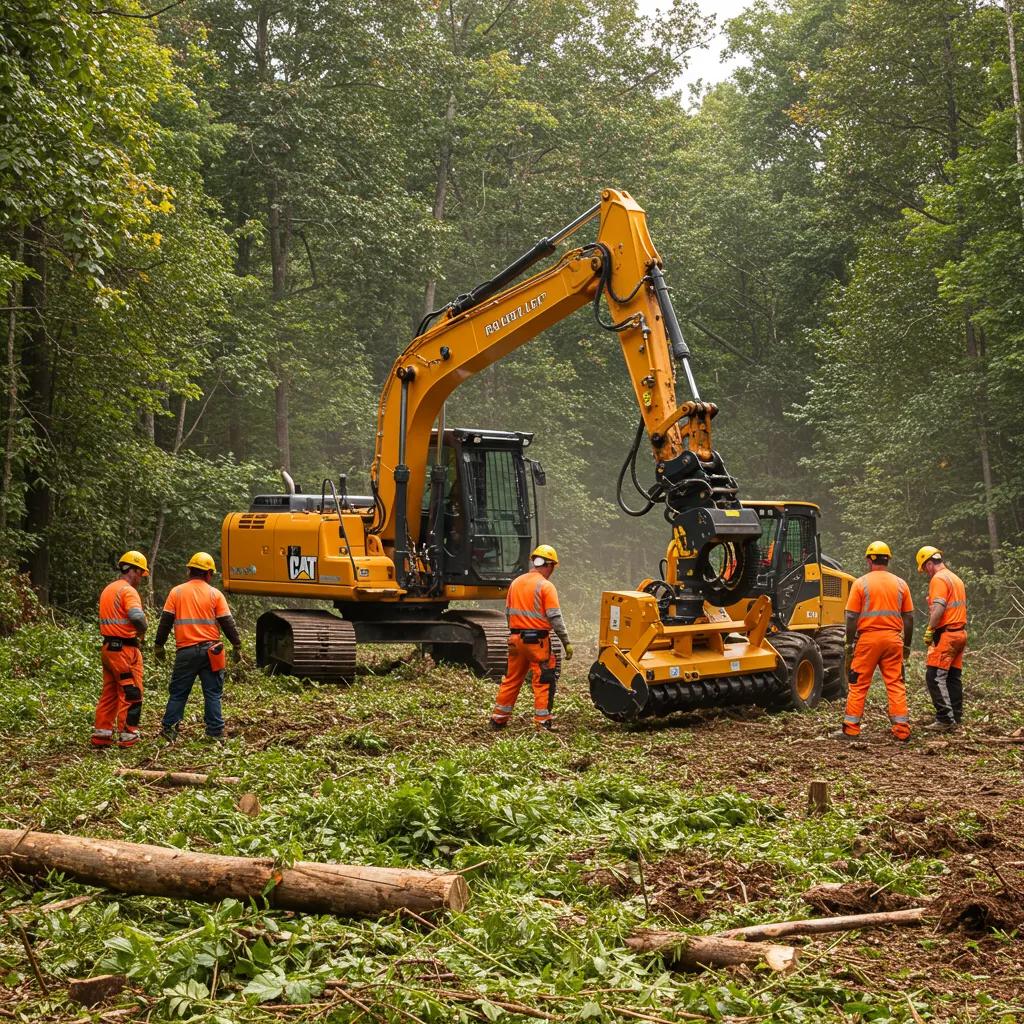
Equipment selection is a tradeoff between mobility, cutting capacity, and terrain suitability; forestry mulchers excel at ecological clearing with lower soil disturbance, while heavy dozers or excavators handle bulky stumps and dense brush more quickly on open land. Appropriate mulcher head sizing, skid-steer attachments, and excavator-mounted options determine productivity per hour and crew composition. Regular maintenance schedules and rapid access to replacement parts minimize downtime and protect utilization rates. Choosing the right mix aligns crew size and equipment with target job types, preserving margin on both small and large jobs.
Before reviewing the CRM systems that capture leads, it helps to compare equipment and techniques in a compact reference.
| Equipment / Technique | Best Use Case | Effect on Efficiency / Safety |
|---|---|---|
| Forestry Mulcher | Brush, small trees, environmental clearing | Preserves soil, reduces haul-off costs |
| Excavator + Mulcher Head | Uneven terrain, larger trees | Higher power, greater throughput per hour |
| Dozer/Grader Clearing | Heavy debris, land leveling | Fast bulk clearing, needs debris removal plan |
How Do CRM and Automation Optimize Sales and Lead Management?
CRM and automation shorten the sales cycle by capturing lead source, auto-qualifying by job size, and triggering scheduled follow-up sequences that convert more inquiries into site visits and proposals. Common automation flows include immediate booking options, SMS/phone confirmations, templated proposals with mobilization estimates, and post-job satisfaction checks that request reviews. Tracking lead-to-booked-job conversion rates and average job value by source enables smarter ad spend allocation and improves lifetime value calculations. Applying simple automations eliminates manual follow-up gaps that otherwise allow high-value prospects to disappear.
What Safety Protocols Ensure Efficient and Risk-Free Land Clearing?
Safety protocols—daily briefings, documented site assessments, clear barrier and utility-marking procedures, and required PPE—reduce incident rates and protect margins by minimizing work stoppages and claims. Training cadence and documented procedures ensure crews apply consistent techniques for hazard recognition and machine operation. Pre-job coordination with utility providers and clear vegetation-management plans mitigate major risks on developed sites. Safety practices are not optional; they are a performance lever that lowers insurance and supports premium pricing from risk-averse clients.
How Do Successful Land Clearing Businesses Build Trust and Retain Clients?
Successful land clearing businesses treat trust and retention as operationalized systems rather than ad-hoc outcomes, combining clear communication, visible guarantees, and structured aftercare to convert one-off work into recurring revenue. Proven practices include formal scope-of-work documents, post-job follow-up surveys, and maintenance or inspection products that lock in repeat engagement. Reputation management and strategic use of 5-star reviews amplify local trust and lower acquisition costs. The subsections below outline customer service, review strategies, and contract approaches that extend client lifetime value.
What Customer Service Practices Enhance Client Satisfaction?
High-performing contractors set clear expectations up front with structured scopes of work, milestone communication, and on-site point-of-contact protocols that reduce ambiguity. Post-job follow-ups, photo documentation, and warranty or inspection offers reassure clients and increase referral likelihood. Staff training on client communication and an organized escalation path for issues turn potential complaints into loyalty-building opportunities. Implementing these service habits creates a referral engine that reduces reliance on paid acquisition over time.
How Do 5-Star Reviews and Testimonials Influence New Business?
Online reviews and testimonials significantly impact click-through rates and perceived trust for local searches and service pages, improving both organic visibility and conversion on paid landing pages. Simple processes—automated review requests after job completion, in-person asking with a quick link, and showcasing reviews on GBP and service pages—increase the volume of high-quality testimonials. Using verified project photos with each testimonial strengthens credibility and helps prospective clients visualize outcomes. A steady inflow of reviews supports long-term lead quality improvements and local authority.
What Strategies Convert Leads into Long-Term Contracts?
- Effective retention tactics that top contractors use include:
- Standardized proposals and scope documents to eliminate scope creep.
- Maintenance and retainer packages to convert one-offs into recurring revenue.
- Follow-up and review capture processes to amplify referral-based lead flow.
Owners should measure client lifetime value and push for contract forms that reduce churn.
Next, we consider the partner ecosystem that grows capacity and market reach.
Who Do the Best Land Clearing Companies Partner With to Maximize Growth?
Top contractors form partnerships that extend operational capacity, reduce cost per job, and amplify lead generation through strategic alliances. Key partners include marketing agencies, equipment suppliers and rental houses, landscapers and developers for referral work, and local trade organizations for joint bidding. Partnerships reduce downtime, provide flexible equipment access, and create co-marketing opportunities that increase visibility for larger contracts. Below, each partner type and its concrete value to scaling firms is described.
How Do Marketing Agencies Like Rise Online Advertising Support Growth?
Marketing agencies focused on the niche can convert marketing activity into booked, high-ticket land clearing jobs by managing channels, optimizing sales processes, and implementing CRM automations that close more leads. Rise Online Advertising LLC specifically aims to Build Trust & Provide Value to Land Clearing Business Owners by delivering a Land Clearing Growth System that combines SEO, Google Ads, Facebook and TikTok campaigns, website development, sales process optimization, and CRM/automation implementation. As an example partner, a specialized agency can operationalize channel management, set up appointment and proposal automations, and provide training via Results and Training pages so teams internalize tactics and scale booked-job volume. Agencies like this should be engaged when a contractor needs to convert marketing investment into measurable booked jobs rather than raw leads.
What Role Do Equipment Suppliers and Local Businesses Play?
Equipment suppliers, rental houses, and local landscapers extend capacity by offering fast access to replacement parts, leased machines, and complementary referral sources. Reliable supplier relationships reduce lead time for repairs and lower the impact of breakdowns on utilization, while landscapers and developers act as referral channels for recurring clearing or multi-phase site work. Co-marketing with suppliers—such as shared before/after showcases—can expose a contractor to adjacent customer segments and accelerate geographic expansion. Structuring referral agreements with clear lead attribution preserves margins and incentivizes partner performance.
How Do Client and Vendor Relationships Impact Business Expansion?
Strong client and vendor relationships enable contractors to pursue larger, multi-site projects with predictable delivery and financing models. Long-term contracts allow strategic equipment purchases and crew expansion because revenue becomes forecastable, while vendor SLAs for parts and service lower the risk of catastrophic downtime during big projects. Joint bidding or consortium approaches with other contractors and suppliers allow access to projects that exceed a single firm’s capacity. Investing in relationship management—regular account reviews, joint planning sessions, and transparent performance metrics—creates the trust foundation required for geographic and vertical expansion.
- Types of partners that directly affect capacity and margin include:
- Equipment suppliers and rental houses for flexible capacity.
- Marketing agencies for predictable lead-to-booked-job funnels.
- Trade and local business partners for referrals and joint bids.
| Equipment / Partner | Attribute | Value |
|---|---|---|
| Rental houses | Fast access to large machines | Reduced capital outlay, faster scale-up |
| Landscaping firms | Referral source for finished-site work | Higher average job value and repeatability |
| Marketing agencies | Channel management + automations | Improved booked-job consistency |
What Financial and Scaling Strategies Do Top Land Clearing Companies Use?
Top land clearing companies adopt pricing and scaling strategies that protect margins while enabling capacity growth, favoring models that match job variability and cash-flow realities. Successful firms blend per-acre pricing for predictable terrain, per-project pricing for complex sites, and minimum-job thresholds to preserve margins on small work. They also use leasing and phased equipment purchases to avoid over-leveraging operations. Below, examine pricing models, debt-free scaling approaches, and ROI measurement frameworks that leaders use.
How Are Pricing Models Structured for Maximum Profitability?
Pricing models are chosen to align risk and reward: per-acre pricing works for consistent, open-terrain jobs, per-project bids are better for variable scope and complex permitting, and hourly rates can protect margins on uncertain-sites. Effective bids include mobilization, disposal, permitting, and contingency line items to avoid margin erosion. Setting minimum job sizes and tiered pricing for larger acreage preserves profitability on smaller jobs while rewarding scale. Regularly benchmarking average job value and attaching margin targets to bid templates ensures pricing remains profitable as costs change.
What Are Effective Debt-Free Growth and Expansion Methods?
Debt-free growth approaches include equipment leasing or renting to test new markets, phased expansion funded by retained earnings, and strategic partnerships that share resource costs. Leasing reduces upfront capital needs and preserves balance-sheet flexibility while rentals can plug temporary capacity gaps during peak seasons. Profit-driven expansion—reinvesting a fixed portion of net operating income into capacity—avoids overextension and aligns growth with market demand. Alliances and subcontracting let firms compete for larger projects without heavy fixed-asset investment.
How Is ROI Measured in Forestry Mulching and Land Clearing Services?
Key KPIs include cost-per-booked-job, lead-to-booking conversion rate, average job value, utilization rate, and downtime impact on weekly capacity; combining these metrics provides a marketing and operations ROI picture. Marketing ROI is best expressed as cost-per-booked-job and LTV/CAC for retained clients, while operational ROI focuses on utilization percentage and revenue per operating hour. Sample calculations—such as converting a 10% lift in utilization into incremental monthly revenue—clarify investment decisions for new equipment or a marketing pilot. Regularly reviewing these KPIs allows leaders to reallocate spend toward the highest-return channels and assets.
| Pricing Model | Margin Impact | Recommended Use Case |
|---|---|---|
| Per-acre | Predictable margins on uniform land | Large, open-site clearing |
| Per-project | Protects margin on complex sites | Jobs with unknown underground/permits |
| Hourly / Minimum | Ensures minimum revenue per mobilization | Small, fragmented local work |
What Can We Learn from Case Studies of America's Best Land Clearing Companies?
Case studies of top land clearing firms reveal repeatable patterns: targeted marketing that produces bookable leads, sales processes that convert with consistent follow-up, and operational upgrades that allow handling larger volumes without margin loss. Examining before/after metrics and the specific tactics applied—channel mix, automation flows, equipment changes—permits replication in similar markets. Below are three H3s that summarize high-ROI client stories, the tactics that drove results, and a 90-day replication roadmap.
How Did Clients Achieve 10x ROI and Significant Revenue Growth?
High-ROI results commonly stem from combining a disciplined Local SEO program, a small paid search test focused on high-intent keywords, and CRM automations that reduced lead leakage by capturing immediate appointment bookings. In one illustrative path, a client reduced response time, automated proposal delivery, and reallocated ad spend to perform at-scale keywords, producing a sharp increase in booked jobs and average order value. Operational upgrades—right-sizing equipment and scheduling—allowed the firm to convert leads into revenue without proportional increases in fixed costs. These combined changes produced stepwise growth measurable in booked-job increases and improved margin per job.
What Marketing and Sales Tactics Drove Their Business Transformation?
Tactics that consistently appear in successful case studies include targeted service pages for high-value offerings, remarketing sequences that recapture proposal viewers, and templated proposals with mobilization estimates that shorten the negotiation window. Ad creatives that showcase before/after imagery and short process videos improve ad performance and reduce lead friction. CRM automations capturing source, job size, and follow-up sequences prevent manual slip-throughs and boost the lead-to-booked-job conversion rate. These specific playbook items create predictable pipelines when implemented with measurement discipline.
How Can Other Land Clearing Businesses Replicate These Results?
A practical 90-day replication roadmap focuses on audit, quick wins, and scaling: first audit GBP and service pages, fix tracking and lead attribution, then launch a small paid search and remarketing test while implementing CRM automations for immediate booking. Quick wins include minimum-job pricing, templated proposals, and a focused review-capture process to improve local trust signals. Scale what converts to booked jobs by incrementally increasing ad budgets and adding capacity through leasing or subcontracting. For owners seeking support, Build Trust & Provide Value to Land Clearing Business Owners is the guiding purpose of specialized partners who can help operationalize these steps; Discover how Rise Online Advertising can help your business join the ranks of America’s best. Book a free strategy call today.
- Replication checklist for the first 90 days:
- Audit and optimize Google Business Profile and service pages.
- Implement basic CRM automations to capture and book leads.
- Run a focused paid search test and scale based on cost-per-booked-job.
Following this sequence prioritizes immediate booked-job growth and sets the foundation for scalable expansion.
Frequently Asked Questions
What are the key benefits of using CRM systems in land clearing businesses?
CRM systems streamline the sales process by automating lead management, tracking customer interactions, and facilitating follow-ups. They help land clearing businesses capture lead sources, qualify inquiries based on job size, and schedule appointments efficiently. By implementing CRM automation, companies can reduce manual errors, improve response times, and ultimately increase conversion rates from inquiries to booked jobs. This leads to better customer relationships and higher client retention, as businesses can maintain consistent communication and follow-up practices.
How can land clearing companies ensure compliance with safety regulations?
To ensure compliance with safety regulations, land clearing companies should implement comprehensive safety programs that include regular training, documented procedures, and daily safety briefings. Conducting thorough site assessments before starting work and maintaining clear communication with crews about potential hazards is essential. Additionally, companies should stay updated on local regulations and industry standards, ensuring that all equipment and practices meet safety requirements. Regular audits and safety drills can further reinforce a culture of safety within the organization.
What are the advantages of using video content in marketing for land clearing services?
Video content is a powerful marketing tool for land clearing services as it visually demonstrates expertise, safety protocols, and project outcomes. By showcasing before-and-after transformations, companies can build trust with potential clients and highlight their capabilities. Videos can also serve as educational resources, explaining processes and equipment used in land clearing. This not only enhances credibility but also improves engagement on social media platforms, driving more traffic to websites and increasing lead generation through compelling visual storytelling.
How do partnerships with local businesses enhance lead generation for land clearing companies?
Partnerships with local businesses, such as landscapers and real estate developers, can significantly enhance lead generation for land clearing companies. These collaborations create referral networks where businesses can recommend each other’s services to clients. Joint marketing efforts, such as co-hosting events or sharing promotional materials, can also increase visibility in the community. By establishing strong relationships with local businesses, land clearing companies can tap into new customer segments and secure more consistent work through trusted recommendations.
What role does customer feedback play in improving land clearing services?
Customer feedback is crucial for improving land clearing services as it provides insights into client satisfaction and areas needing enhancement. By actively soliciting feedback through surveys and follow-up communications, companies can identify strengths and weaknesses in their operations. This information can guide adjustments in service delivery, safety practices, and customer communication. Additionally, positive feedback can be leveraged in marketing efforts, while addressing negative feedback demonstrates a commitment to customer satisfaction and continuous improvement, ultimately fostering loyalty and repeat business.
What are the best practices for pricing land clearing services competitively?
To price land clearing services competitively, companies should conduct market research to understand local pricing trends and competitor rates. Implementing a tiered pricing structure based on job complexity and size can help accommodate various client needs while preserving margins. Including detailed cost breakdowns in proposals—covering mobilization, disposal, and contingencies—ensures transparency and builds trust with clients. Regularly reviewing and adjusting pricing strategies based on operational costs and market demand will help maintain competitiveness and profitability in the long run.
Conclusion
Top land clearing companies leverage strategic partnerships, innovative marketing, and operational excellence to drive consistent growth and client satisfaction. By understanding the key metrics and best practices outlined in this guide, contractors can enhance their lead generation and conversion processes effectively. Embrace these insights to transform your business and achieve sustainable success in the competitive land clearing industry. Discover how our specialized services can help you implement these strategies and elevate your operations today.